
Free Lesson: Airbnb Arbitrage – What It Is, Why Landlords Resist It & the Margin Reality
Free Lesson: Airbnb Arbitrage – What It Is, Why Landlords Resist It & the Margin Reality
Introduction
Airbnb arbitrage means leasing a property long-term at a fixed rent, running it as a short-term rental with the landlord’s written permission, and keeping the spread after every cost. It’s an operating business, not a property investment: in our example $13,000 a month gross becomes about $1,650 net once Airbnb’s 15.5% fee plus GST, rent, cleaning and running costs come out, and a 20% quieter month leaves almost nothing.
⚡ THE 5-MINUTE VERSION
Arbitrage means you lease a property long-term, run it as a short-term rental with written permission, and keep the spread after every cost. No ownership, no capital growth: it’s an operating business built on margin, so the numbers must survive a bad month.
Why this matters
The objection you’ll hear is “Why should I let someone else make money from my property?” The answer isn’t asking the landlord to share their upside. You’re offering an above-market, fixed-rent, professionally managed lease where the operating risk sits with you. Every lesson in this module builds the proof of that. But first you need to know exactly what you’re signing up for, because a lease doesn’t create profit. It creates an obligation.
What arbitrage is, and why it triggers resistance
Arbitrage means capturing the price difference between two markets. In property: you lease a home long-term at a fixed rent, operate it as a short-term rental, and keep what’s left after every expense. Subleasing isn’t new. A student who leases a four-bedroom house for $900 a week and rents each room at $350 has a $500 weekly spread. Airbnb changed two things. Visibility: a listing is public, so neighbours, councils, strata managers and landlords will find it. The question isn’t “will anyone notice?” but “when?”, which is why this module never teaches arbitrage without written permission. Use category: a full short-term conversion takes a home out of the long-term rental pool, and that, not the margin, is what drew public and political attention.
Landlords fear damage, their insurance being voided, rent default when bookings slow, strangers rotating through the home, and “if you can make money, why don’t I?” Agents fear extra work, complaints and being blamed. Councils, strata and the community worry about housing supply, noise and rule breaking. None of these fears are irrational; they’re incentive-driven. Don’t argue with them. Show, in writing, that each is already controlled: damage protection (Lesson 4), insurance and a written clause (Lessons 5 and 6), serviceability and reserves (Lesson 3), guest screening and noise monitoring (Lesson 7), conservative numbers, a clean proposal pack (Lessons 8 to 13) and full compliance (Lesson 2). Most operators keep their structures secret; we take the opposite approach, because transparency gets approvals that last.
What good looks like
This course wasn’t built as an arbitrage course but for clients who want their Airbnb to perform, whatever the structure. There are two parts to arbitrage and most people only prepare for the first. Getting the lease is communication, documents and relationships, and manageable when done professionally. Making it perform (pricing, listing, guest experience, cleaning, reviews, cost control) is where most operators fail, and it’s what the rest of the course teaches.
The amateur leads with “we’ll pay more rent”, uses gross revenue screenshots, assumes Airbnb covers damage, rushes past concerns and says “if I get the lease, I’ll figure it out”. The professional leads with structure and risk control, models net profit at the 25th percentile, holds their own insurance and protection layers, answers every fear before it’s asked, and has systems, reserves and an exit plan before signing.
Know what you’re choosing. Ownership gives income plus capital growth, often some tax buffers, and if short-term underperforms you can switch to long-term rent or hold. Arbitrage gives income only, very limited tax buffers, and the rent is due every week whatever bookings do. That’s why we prioritise ownership first: rent never compounds. Arbitrage is still a legitimate way in and a real stepping stone towards ownership, if you treat it as a business. Accessible doesn’t mean low risk.
The margin reality check
Those $20,000-a-month posts are gross revenue. Net profit decides whether you survive. In the lesson’s illustrative month:
Start with $13,000 of advertised gross revenue. Airbnb’s host-only fee (15.5% + 10% GST ≈ 17.05%) takes $2,217, leaving $10,783. Rent at $750 a week (× 52 ÷ 12) is $3,250, leaving $7,533. Cleaning and linen for a high-turnover property take $3,000 ($4,533 left), utilities $1,000 ($3,533 left), and consumables and minor maintenance $500 ($3,033 left). The channel manager (OwnerRez, about US$55 ≈ A$80 a month) is $80 ($2,953 left), other software, insurance and subscriptions $500 ($2,453 left), and furnishing ($25,000 over 3 years, rounded up for replacements) $800. What’s left is $1,653 a month.
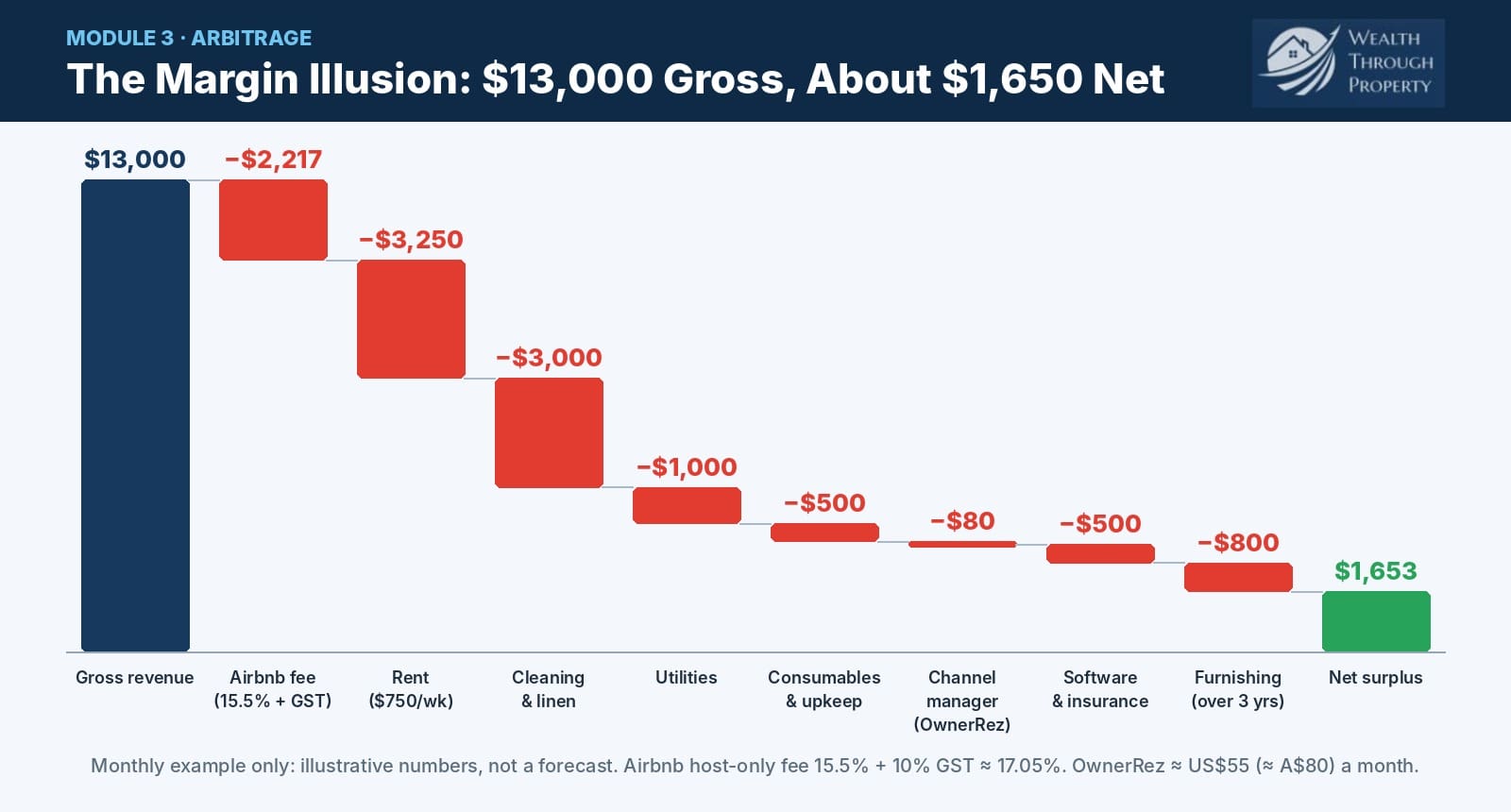
Every step from this lesson’s example, in one picture.
The “$9,750 spread” your brain first calculated (revenue minus rent) is really about $1,650 a month, and that assumes no slow months, surprise repairs or regulation changes. Why 17.05%? Airbnb’s host-only fee is 15.5% of the booking subtotal, and for most Australian hosts Airbnb adds 10% GST on top. If you’re GST-registered and have given Airbnb your ABN, check your payout breakdown, because it can be treated differently. Your channel manager is a separate monthly cost: OwnerRez is about US$55 a month (about A$80; check current pricing).
Watch out: don’t count the Management Fee (cleaning fee) as profit. If your gross revenue includes the Management Fee (cleaning fee) and linen fees guests pay, the full cleaning cost must sit below the line, as it does here.
Now stress-test it. In a 20% quieter month, revenue falls to $10,400 and fees, cleaning and consumables shrink a little, but rent, utilities, the channel manager, software, insurance and furnishing don’t move. The month goes from +$1,653 to just $197, and at about 25% quieter it’s a loss. That’s the core truth of arbitrage: fixed costs inside a variable-revenue market. It’s also why operators scale to 10, 20 or 30 properties: per-property margins are moderate and volume smooths the volatility.
Ask the questions a business owner asks: What if occupancy drops 20%? What if rates compress as new listings arrive? What if council or state rules change? What if one bad month wipes out three good ones? How many months of rent could I cover from savings if bookings stopped tomorrow? Optimism bias and social proof (screenshots, lifestyle posts) show you the highlight reel, not the failed leases, insurance rejections and break-even months. Model it conservatively.
Run the Deal Reality Check
The lesson’s template (also a Word download) sets out the same lines for a real property at the 25th and 50th percentile, using third-party revenue data. Then run the stress test (net surplus if revenue drops 20%, months of rent you can cover, other income) and the go/no-go: positive at the 25th percentile, a 20% quieter month doesn’t force you to miss rent, at least 3 months’ rent in reserve (5 at launch), revenue from third-party data rather than a best-case screenshot, and the property can legally be used for short-term rental. Decide GO, NO-GO or RENEGOTIATE, with a one-sentence reason.
Skye’s Beach House is owned, not leased, but it performs because of its systems, and those matter even more under a fixed rent: nightly rates and minimum stays in PriceLabs, length-of-stay discounts in OwnerRez, a signed rental agreement with ID and selfie before check-in details are released, per-booking damage protection, split listings, and photo-checked cleans after every turnover. If you can’t run these yet, learn them in the setup and optimisation modules first. The lease gets you in; operations keep you alive.
Common mistakes: “if I can just get the lease, I’ll figure it out”; using gross revenue or a best-case projection instead of the 25th and 50th percentile; counting the Management Fee (cleaning fee) as income while forgetting the cleaner’s invoice; leaving furnishing out because it was paid upfront; listing without written permission; and treating it as hosting instead of a business with fixed costs, forecasts and an exit plan.
📥 Download the templates for this lesson
- Deal Reality Check (Word): run the numbers on any property in 15 minutes, at the 25th and 50th percentile
Open in Word or Google Docs (File → Open → Upload), then save your own copy before filling it in.
Deal Reality Check: copy this
DEAL REALITY CHECK

Property: ______________________   Date: ____________
Revenue source: ______________________ (WTP estimate tool / AirDNA / comparable listings)

MONTHLY NUMBERS
Write a conservative (25th percentile) and an expected (50th percentile) figure on each line. The figure in brackets is this lesson’s illustrative example.

Gross revenue: 25th $______   50th $______   (example $13,000)
Platform and channel fees (____%): 25th −$______   50th −$______   (example −$2,217: Airbnb host-only fee 15.5% + 10% GST ≈ 17.05%)
Rent: 25th −$______   50th −$______   (example −$3,250: $750 a week × 52 ÷ 12)
Cleaning and linen: 25th −$______   50th −$______   (example −$3,000)
Utilities: 25th −$______   50th −$______   (example −$1,000)
Consumables and minor maintenance: 25th −$______   50th −$______   (example −$500)
Channel manager: 25th −$______   50th −$______   (example −$80: OwnerRez ≈ US$55 ≈ A$80)
Other software, insurance, subscriptions: 25th −$______   50th −$______   (example −$500)
Furnishing spread over the lease: 25th −$______   50th −$______   (example −$800)
NET SURPLUS: 25th $______   50th $______   (example $1,653)

STRESS TEST
Net surplus if revenue drops 20%: $______   (example $197)
Months of rent I can cover from savings: ______ months
Do I have income outside this property? ______ (yes / no, amount)

GO / NO-GO (tick each one)
[ ] The deal is positive at the conservative (25th percentile) case.
[ ] A 20% quieter month does not force me to miss rent.
[ ] I can hold at least 3 months’ rent in reserve (5 at launch, see Lesson 3).
[ ] Revenue figures come from third-party data, not a best-case screenshot.
[ ] I have checked the property can legally be used for short-term rental (Lesson 2).

Decision: GO / NO-GO / RENEGOTIATE
Reason (one sentence): ______________________________
✅ Do this now
- Complete the Deal Reality Check for one real property at the 25th and 50th percentile.
- Run the 20% stress test and write down the result.
- Write down how many months of rent you could cover from savings if bookings stopped.
- Work out your walk-away rent: the most you could pay and still break even in a conservative month.
- Answer every question in Part 6 in writing before you contact an agent.
- Decide honestly: is this a business with systems, reserves and insurance, or a side hustle? Only continue if it’s the first.
Before you speak to a single agent, you need three things clear in your head: what arbitrage actually is, why landlords and agents instinctively resist it, and whether the numbers survive a bad month. This lesson gives you all three, plus a deal check you can run on any property in 15 minutes.
THE OBJECTION THIS LESSON ANSWERS
“Why should I let someone else make money from my property?”
You are not asking the landlord to share their upside. You are offering an above-market, fixed-rent, professionally managed lease where the operating risk sits with you. Every lesson in this module builds the proof of that.
IN THIS LESSON
- Why landlords care: what arbitrage is and why it triggers resistance
- Every fear has an answer: how Module 3 handles each one
- What good looks like: the operators who last
- Step-by-step: the margin reality check
- Worked example: one deal, from first look to decision
- Before you approach an agent: the questions to answer
- Template: Deal Reality Check worksheet
- What we do at Skye’s / WTP
- Common mistakes, and the fix for each
- Key terms, self-check and what’s next in Module 3
- Check your work & do this now
Part 1 of 11 · Why landlords care
What arbitrage is, and why it triggers resistance
The true definition
Arbitrage began in financial markets. It simply means capturing the price difference between two markets. In property, Airbnb arbitrage is:
- You lease a property long-term at a fixed rent.
- You operate it as a short-term rental.
- You keep the spread between long-term rent and short-term revenue, after every expense.
There is no ownership. There is no capital growth. It is not a property investment. It is an operating business built on margin. That distinction drives everything else in this module.
It isn’t new. Airbnb just made it visible
Subleasing has existed for generations. Picture a four-bedroom house leased for $900 a week. The student on the lease rents each room for $350 a week: $1,400 coming in, $900 going out, a $500 weekly spread. Retail tenants do the same with floor space. Control the lease, restructure the income, capture the spread.
Two things changed when Airbnb arrived:
- Visibility. A listing is public. Neighbours, councils, strata managers and landlords can all find it by scrolling the suburb. You cannot “quietly” Airbnb a property. The question is not “will anyone notice?” but “when?” That is why this module never teaches arbitrage without written permission.
- Use category. A student sublease still houses long-term residents. A full short-term conversion takes the home out of the long-term rental pool. That, not the margin, is what drew public and political attention.
Who resists, and what actually reduces it
Four groups push back, each for its own reasons. Here is what each one fears and what reduces that fear. Part 2 shows where in Module 3 you learn each answer.
Landlords have five fears:
- Damage and worst-case stories. Reduced by layered damage protection (Lesson 4) and guest controls (Lesson 7).
- Their insurance being voided. Reduced by the right insurance structure and a written clause (Lessons 5 and 6).
- Rent default when bookings slow. Reduced by serviceability, reserves and exit thresholds (Lesson 3).
- Strangers rotating through the home. Reduced by screening, ID, signed agreements and noise monitoring (Lesson 7).
- “If you can make money, why don’t I?” Reduced by conservative numbers, never hype (Lessons 3 and 13).
Agents fear extra work, complaints and being blamed. A clean proposal pack that makes their job easy (Lessons 8 to 13) reduces it.
Councils, strata and the community worry about housing supply, noise and rule breaking. Full compliance and permission in writing (Lesson 2) reduce it.
Other Airbnb owners resent competition from people without capital at risk. The answer is to operate to a higher standard than they do.
Notice the pattern. None of these fears are irrational. They are incentive-driven. Your job is not to argue with them. It is to show, in writing, that each one is already controlled.
Part 2 of 11 · Every fear has an answer
How Module 3 answers each fear
This is a free lesson from Module 3, so here is the map of what comes next. Every fear above has a lesson that turns it into a written, checkable answer. Notice that none of the answers is “trust me”. Each one is a document, a system or a number the landlord can see for themselves.
“Is this even allowed?” → Lesson 2
Is It Allowed? Lease Consent, Strata, Council & State Rules comes first for a reason. Platforms don’t grant permission. The lease and the law do. You check each layer in order: the lease terms, the strata by-laws, the council, the state rules, safety obligations and insurance. Then you record it all in a compliance register.
Rules differ by state and council and they change often (NSW, for example, has a state register for short-term rental accommodation), so the lesson shows you how to check the current rules yourself rather than relying on anyone’s summary. A landlord or agent who sees you’ve done this homework stops seeing you as a risk to them.
“What if you can’t pay the rent?” → Lesson 3
The Numbers: Break-Even, Serviceability & Reserves is the landlord’s credibility test. You show income outside the property, a dedicated reserve (at least three months’ rent, and five at launch), conservative modelling at the 25th to 50th percentile, and a written exit threshold: the point at which you tell the landlord early, so they’re never surprised by a vacancy. The margin maths in this lesson is the first step of that work.
“What if my property gets trashed?” → Lesson 4
Damage Protection: The Three Levers That Reassure Landlords gives you three levers: your own public liability cover, per-booking damage protection that is active every time a guest checks in, and a security deposit used as a negotiation lever rather than a default. Small damage becomes your cost, not theirs.
“Will my insurance still pay?” → Lessons 5 and 6
Insurance: The Hidden Risk Nobody on Instagram Talks About explains why “Airbnb covers it” is incomplete, why claims should climb a ladder with the landlord’s policy as the last resort, and which questions to put to insurers in writing. The Insurance & Asset Protection Clause for Landlords and Agents turns that into a clause the landlord can read and agree to.
“Who is actually staying in my house?” → Lesson 7
Guest Management Systems That Landlords Trust replaces “strangers every few days” with a control stack: screening, your own ID check, a signed rental agreement before check-in details are released, privacy-safe noise monitoring (no cameras inside), firm rules, and a three-tier incident model that tells the landlord what they need to know, when they need to know it.
“Why should I deal with you?” → Lessons 8 to 13
Agents are busy, and a messy request is an easy no. Lessons 8 to 13 build the proposal pack that makes yes the easy answer: Your Proposal Pack: Positioning & the Master Template, Defining Your Property Brief (The Eight Drivers), The Combined Brief for Property Managers and Landlords, The Property Evaluation Report, The Email Proposal and The Presentation & Agent Call: Turning Structure Into Persuasion.
Conservative numbers run through all of it. That is how you answer “if you can make money, why don’t I?” without sounding defensive: you show a modest, believable margin and make clear that the fixed rent and the operating risk sit with you.
“What am I actually signing?” → Lesson 14
Lease Terms: Pricing, Lease Length, Rent Reviews & Exit closes the module. It covers the rent you offer, how long the lease should run, how rent reviews are set and how either side can exit cleanly. A fixed cost in a variable market has to be negotiated with care, because you live with those terms for years.
Tip: The order matters. Permission first, numbers second, protection third, proposal fourth, lease terms last. Most beginners start at the proposal, which means they’re pitching a deal they haven’t yet proven is allowed or affordable.
Part 3 of 11 · What good looks like
The operators who last
A note from Scott: this course was not created as an arbitrage course. It was created for our clients, people who want their Airbnb to perform. Some own, some co-host, some self-host, some run arbitrage. The structure doesn’t matter. Performance does. Arbitrage operators asked for this material because most arbitrage courses (some charge $10,000 to $15,000) teach you how to get the lease and almost nothing about how to make it perform.
There are two parts to arbitrage, and most people only prepare for the first:
The first part: getting the lease. This is communication, documents and relationships. It is manageable when done professionally. What it creates is an obligation. This module teaches it.
The second part: making it perform. This is pricing, listing, guest experience, cleaning, reviews and cost control. It is where most operators fail. What it creates is profit (or losses). The rest of this course teaches it.
Agents and landlords sort applicants quickly. This is what separates the amateur who gets ignored from the professional who gets a yes:
- The pitch. The amateur leads with “we’ll pay more rent” and upside. The professional leads with structure and risk control.
- The numbers. The amateur uses gross revenue screenshots. The professional models net profit at the 25th percentile.
- Damage. The amateur assumes Airbnb covers damage. The professional holds their own insurance and protection layers.
- Concerns. The amateur rushes past landlord concerns. The professional answers every fear before it’s asked.
- The plan. The amateur says “If I get the lease, I’ll figure it out.” The professional has systems, reserves and an exit plan before signing.
Ownership vs arbitrage: know what you are choosing
- Income. Both give you income.
- Capital growth and equity. Ownership: yes. Arbitrage: no.
- Tax buffers (depreciation, gearing where available). Ownership: often. Arbitrage: very limited.
- If short-term underperforms. An owner can switch to long-term rent, or hold. An arbitrage operator’s rent is still due every week.
- Main pressure. Ownership carries capital and debt risk. Arbitrage carries immediate cash-flow pressure.
This is why we prioritise ownership first. Not because arbitrage can’t work, but because rent never compounds. Arbitrage is still a legitimate way in, and a real stepping stone towards ownership, if you treat it as a business. Accessible does not mean low risk.
Part 4 of 11 · Step-by-step
The margin reality check
You have probably seen someone advertise $20,000, $30,000 or $50,000 a month from properties they don’t own. That is gross revenue. What decides whether you survive is net profit. Let’s walk an example so your brain stops calculating emotionally and starts calculating structurally.
EXAMPLE ONLY. ILLUSTRATIVE NUMBERS, NOT A FORECAST
| Step | Line (monthly) | Amount | Running total |
|---|---|---|---|
| 1 | Advertised gross revenue | $13,000 | $13,000 |
| 2 | Airbnb host-only fee (15.5% + 10% GST ≈ 17.05%) | −$2,217 | $10,783 |
| 3 | Rent ($750 a week × 52 ÷ 12) | −$3,250 | $7,533 |
| 4 | Cleaning and linen (high turnover) | −$3,000 | $4,533 |
| 5 | Utilities: power, water, gas, internet | −$1,000 | $3,533 |
| 6 | Consumables and minor maintenance | −$500 | $3,033 |
| 7 | Channel manager (OwnerRez, about US$55 ≈ A$80 a month) | −$80 | $2,953 |
| 8 | Other software (pricing tool and the like), insurance, subscriptions | −$500 | $2,453 |
| 9 | Furnishing: $25,000 over 3 years (≈$694, rounded up to $800 for replacements) | −$800 | $1,653 |
The “$9,750 spread” your brain first calculated (revenue minus rent) is really about $1,650 a month. Still positive, but it assumes no slow months, no surprise repairs and no regulation changes.
Tip: Why 17.05%? Airbnb’s host-only fee is 15.5% of the booking subtotal, and for most Australian hosts Airbnb adds 10% GST on top, so about 17.05% comes out of every booking. If you’re GST-registered and have given Airbnb your ABN, check your payout breakdown, because it can be treated differently. Booking.com and Vrbo charge differently, so use your real channel mix. Your channel manager is a separate monthly cost on top: OwnerRez is about US$55 a month for one property with the features we use (about A$80; check current pricing).
Watch out: Don’t count the Management Fee (cleaning fee) as profit. If your gross revenue includes the Management Fee (cleaning fee) and linen fees guests pay, the full cleaning cost must sit below the line, as it does here.
Now stress-test it: what does a 20% quieter month do?
EXAMPLE ONLY
| Line (monthly) | Normal month | 20% quieter month |
|---|---|---|
| Gross revenue | $13,000 | $10,400 |
| Airbnb fee (17.05%) | −$2,217 | −$1,773 |
| Rent (fixed) | −$3,250 | −$3,250 |
| Cleaning and linen (fewer stays) | −$3,000 | −$2,400 |
| Utilities (fixed) | −$1,000 | −$1,000 |
| Consumables | −$500 | −$400 |
| Channel manager, software and insurance (fixed) | −$580 | −$580 |
| Furnishing (fixed) | −$800 | −$800 |
| Net | $1,653 | $197 |
A 20% dip wipes out almost all of the profit ($1,653 becomes $197), and at about 25% quieter the month is a loss, because your biggest costs are fixed. That is the core truth of arbitrage: fixed costs inside a variable-revenue market. It is also why operators scale to 10, 20 or 30 properties. Per-property margins are moderate, and volume smooths the volatility.
Why the profit disappears so fast
Look at which lines moved in the stress test. Only three costs shrink when bookings drop: the Airbnb fee, cleaning and linen, and consumables. Together they take about 44 cents of every booking dollar in this example (17.05% in fees, about 23% in cleaning and linen, about 4% in consumables).
Everything else is fixed: rent, utilities, the channel manager, other software and insurance, and furnishing. That is $5,630 a month, and it is due whether the property is full or empty.
So every dollar of revenue you lose costs you about 56 cents of profit. A 20% quieter month removes $2,600 of revenue and about $1,456 of profit, which is exactly how $1,653 becomes $197. The month breaks even at roughly $10,050 of revenue, about 23% below the normal month. Anything quieter than that is a loss.
Tip: A quick rule of thumb: divide your monthly fixed costs by the share of each booking dollar you keep after variable costs. That is your break-even revenue. Here it is $5,630 ÷ 0.56 ≈ $10,050. Lesson 3 does this properly, for a full year, and adds break-even occupancy.
The questions a business owner asks (a host doesn’t)
- What happens if occupancy drops 20%?
- What happens if nightly rates compress because new listings arrive?
- What happens if the council or state rules change?
- What happens if one bad month wipes out three good ones?
- How many months of rent could I cover from savings if bookings stopped tomorrow?
Humans have optimism bias: we overestimate good outcomes and discount risk, and social proof (screenshots, lifestyle posts) makes it worse. You are seeing the highlight reel, not the failed leases, insurance rejections and break-even months. Expect it to be hard, model it conservatively, and you give yourself a real chance.
Part 5 of 11 · Worked example
One deal, from first look to decision
EXAMPLE ONLY. AN ILLUSTRATIVE DEAL, NOT A REAL PROPERTY OR A FORECAST
Let’s run the same numbers the way a professional would. An agent has a three-bedroom house listed at $750 a week. Someone online says houses like it “do $13,000 a month”. That is the figure in the margin table above, and it gives $1,653 a month. Here is what happens when you check it properly.
Step 1. Check it’s allowed before you do any maths
It’s a freestanding house on its own title, so there are no strata by-laws to read. The lease, the council and the state rules still apply. You note the consent questions for the agent, look up the council’s short-term rental page and check whether your state has a register or night limits. Only when nothing rules it out do you spend time on the numbers. Lesson 2 shows you how to do each check.
Step 2. Get three revenue opinions, not one
Instead of trusting the $13,000 claim, you check three sources: the free revenue estimate tool on the Wealth Through Property website, a paid data tool such as AirDNA, and your own look at comparable listings nearby (similar size and quality, with plenty of reviews).
For this example, say they agree on a monthly average of about $11,500 at the 50th percentile (an expected month) and about $9,500 at the 25th percentile (a conservative month). The $13,000 turns out to be closer to a strong month than an average one.
Step 3. Run the numbers at both percentiles
Keep the same cost structure as the margin table. Rent, utilities, the channel manager, other software and insurance, and furnishing stay fixed at $5,630 a month. The Airbnb fee, cleaning and linen, and consumables move with bookings.
- Expected month (50th percentile, $11,500). Airbnb fee −$1,961, rent −$3,250, cleaning and linen −$2,654, utilities −$1,000, consumables −$442, channel manager −$80, other software and insurance −$500, furnishing −$800. Net: about $813.
- Conservative month (25th percentile, $9,500). Airbnb fee −$1,620, rent −$3,250, cleaning and linen −$2,192, utilities −$1,000, consumables −$365, channel manager −$80, other software and insurance −$500, furnishing −$800. Net: about −$307, a loss.
Same house, same rent, same costs. The only thing that changed is where the revenue figure came from. A deal that looked like $1,653 a month is about $800 in an ordinary month and a loss in a soft one.
Step 4. Work out your walk-away rent
Now flip the question: what is the most rent this deal can carry and still break even in a conservative month? Start with the conservative revenue ($9,500). Take off the variable costs ($1,620 + $2,192 + $365) and every fixed cost except rent ($1,000 + $80 + $500 + $800). What’s left, about $2,943 a month, is the most rent the deal can carry. That is about $680 a week.
The asking rent is $750, so even break-even needs a rent the landlord isn’t offering. Offering $70 a week under the asking rent rarely wins a lease, so at this rent the deal is a no-go. Lesson 14 explains how we price the rent we offer.
Step 5. Count the cash you’d need on day one
Even a good deal needs capital. In this example, furnishing of about $25,000 leaves your account before the first guest arrives. The launch reserve from Lesson 3 is five months’ rent, which is $16,250 at $3,250 a month. Lesson 5 adds an insurance contingency of one policy excess plus one month’s rent.
That is more than $44,500 of your own money before the bond and any other move-in costs. If that money isn’t there, the answer is no-go, whatever the margin says.
Step 6. Write the decision down
The Deal Reality Check ends with one line: GO, NO-GO or RENEGOTIATE, and one sentence of reason. For this house: “NO-GO at $750 a week. Positive at the expected case, a loss at the conservative case, and break-even rent is about $680.” Writing it down stops you talking yourself back into it next week when another screenshot appears.
Part 6 of 11 · Before you approach an agent
The questions to answer before you call anyone
Agents remember the applicant who wasted their time. Before you make contact about a property, you should be able to answer every question below in writing. If you can’t, you’re not ready for that property yet, and that’s fine. It is far cheaper to find out now than after you’ve signed.
About the property
- Is it a house, a townhouse or an apartment, and is it part of a strata scheme? Strata by-laws can restrict short-term letting even when the landlord says yes.
- What do the council and state rules say about short-term rental at this address? Write down where you checked and the date.
- Does it suit the guests who actually book in this area (size, layout, parking, location)? Lesson 9 turns this into a property brief built on eight drivers.
- What will it really cost to furnish it to a standard that earns good reviews?
About the money
- What do three independent sources say at the 25th and 50th percentile?
- Is the deal positive at the 25th percentile after every line on the Deal Reality Check?
- What is my walk-away rent: the most I can pay and still break even in a conservative month?
- What does a 20% quieter month do, and could I still pay the rent?
About you
- How many months of rent could I cover from savings if bookings stopped tomorrow?
- Do I have income outside this property, and would a landlord see it as stable?
- Who cleans, who answers guests late at night and who fixes things? If it’s all me, can I keep that up?
- Can I already run pricing, a channel manager, guest screening and turnovers? If not, learn them in the setup and optimisation modules first.
About what you’ll hand over
- Can I show the landlord, in writing, how each of their five fears is controlled?
- Is my proposal built on conservative numbers, with no hype?
- Do I know what lease length, rent review terms and exit terms I want?
Watch out: If you catch yourself answering “I’ll work that out once I have the keys”, stop. That is the sentence this whole lesson is warning you about.
Part 7 of 11 · Template you can copy
Deal Reality Check worksheet
Part 8 of 11 · What we do at Skye’s / WTP
Why the systems matter more than the lease
Skye’s Beach House at Malua Bay is owned, not leased, and that is Scott’s point: ownership first where you can. But the reason it performs is the system behind it, and those systems matter even more when you have a fixed rent and no capital growth to fall back on.
Tip: If you can’t yet run these systems on a property you control, learn them first in the setup and optimisation modules. The lease gets you in. Operations keep you alive.
Part 9 of 11 · Common mistakes
Mistakes that sink arbitrage operators
Watch out: “If I can just get the lease, I’ll figure it out.” Signing a lease doesn’t create profit. It creates an obligation.
Watch out: Using gross revenue or the best-case number from a projection tool. Model the 25th and 50th percentile.
Watch out: Counting the Management Fee (cleaning fee) as income while forgetting the cleaner’s invoice.
Watch out: Leaving furnishing out of the numbers because it was paid upfront.
Watch out: Listing without written permission. Airbnb listings are public and you will be found.
Watch out: Treating it as hosting instead of a business with fixed costs, forecasts and an exit plan.
More beginner mistakes, and the fix for each
Mistake: working out revenue as the nightly rate × 30. No property is booked every night, and the rate you see in peak season isn’t the rate in winter. Fix: use monthly revenue from third-party data at the 25th and 50th percentile, and look at the quietest months on their own.
Mistake: using a flat 20% for “fees”. It blends the Airbnb fee and the channel manager into one guess. Fix: use Airbnb’s host-only fee (15.5% plus 10% GST, about 17.05% for most Australian hosts; check your own payout breakdown) and add the channel manager as its own monthly cost (OwnerRez is about A$80).
Mistake: forgetting the launch gap. A new listing has no reviews yet, and the first weeks can be slower while it earns them. The rent starts on day one. Fix: budget a soft first month or two and hold the five-month launch reserve from Lesson 3.
Mistake: averaging the year and ignoring the quiet season. An annual average hides the months when bookings dip but the rent doesn’t. Fix: stress-test your two quietest months separately.
Mistake: falling for the property instead of the numbers. A beautiful home with weak conservative revenue is still a weak deal. Fix: let the Deal Reality Check decide, and be ready to walk away.
Mistake: pitching the agent before the homework is done. A first impression with an agent is hard to undo. Fix: answer every question in Part 6 first, then approach with a clean proposal pack.
Mistake: having no written exit point. Without one, operators keep paying rent from savings and hoping next month is better. Fix: set your exit threshold before you sign (Lesson 3) and tell the landlord early if you reach it.
Part 10 of 11 · Key terms, self-check & what’s next
Key terms, self-check and what’s next
Key terms
- Gross revenue: everything guests pay, before any cost comes out.
- Net profit (net surplus): what’s left after every cost, including rent, fees, cleaning and furnishing.
- Spread: the gap between what the property earns and what it costs you. The real spread is net profit, not revenue minus rent.
- Fixed costs: costs that don’t change with bookings, such as rent, utilities, software, insurance and furnishing.
- Variable costs: costs that rise and fall with bookings, such as the Airbnb fee, cleaning and linen, and consumables.
- Break-even: the revenue at which you neither make nor lose money.
- 25th and 50th percentile: a conservative and an expected outcome. At the 25th percentile, three in four comparable results are higher. The 50th percentile is the middle.
- Host-only fee: the Airbnb fee setting where the host pays the service fee out of the booking (15.5% plus GST for most Australian hosts).
- Channel manager: software that connects your listings across platforms and manages bookings, calendars and messages in one place. We use OwnerRez.
- Reserve: cash set aside only to pay the rent if bookings fall short.
- Exit threshold: the written point at which you tell the landlord early and plan an orderly exit.
Self-check: test yourself
Answer each question in your head first, then open it to check.
A property “does $13,000 a month” and the rent is $3,250 a month. Is the spread $9,750?
No. That is revenue minus rent. After the Airbnb fee, cleaning and linen, utilities, consumables, the channel manager, other software and insurance, and furnishing, this lesson’s example leaves about $1,653 a month.
Why does a 20% quieter month cut profit by much more than 20%?
Because most costs are fixed. Only the fee, cleaning and consumables shrink, so about 56 cents of every lost revenue dollar comes straight off profit. In the example, $1,653 becomes $197, and at about 25% quieter the month is a loss.
Is the channel manager included in the 17.05% Airbnb fee?
No. The 17.05% is Airbnb’s host-only fee of 15.5% plus 10% GST. The channel manager is a separate monthly cost: about US$55 (about A$80) for OwnerRez.
A deal is positive at the 50th percentile but a loss at the 25th. Go or no-go?
Not a go as it stands. The go/no-go test needs the deal to be positive at the conservative case. Renegotiate the rent if that is realistic, or walk away.
A landlord asks, “If it’s that profitable, why don’t I do it myself?” How do you answer?
Don’t argue and don’t hype. Show your conservative numbers, the modest margin, and the fact that you carry the fixed rent and the operating risk. You are offering them a fixed, professionally managed lease with the risk on your side, not a share of a goldmine.
What’s in the rest of Module 3
This lesson is the first of 14 in Module 3. The rest of the module takes you from “is it allowed?” to a signed lease, in this order:
- Is It Allowed? Lease Consent, Strata, Council & State Rules
- The Numbers: Break-Even, Serviceability & Reserves
- Damage Protection: The Three Levers That Reassure Landlords
- Insurance: The Hidden Risk Nobody on Instagram Talks About
- The Insurance & Asset Protection Clause for Landlords and Agents
- Guest Management Systems That Landlords Trust
- Your Proposal Pack: Positioning & the Master Template
- Defining Your Property Brief (The Eight Drivers)
- The Combined Brief for Property Managers and Landlords
- The Property Evaluation Report
- The Email Proposal
- The Presentation & Agent Call: Turning Structure Into Persuasion
- Lease Terms: Pricing, Lease Length, Rent Reviews & Exit
Most lessons come with templates you can copy, so by the end of the module you have a full proposal pack ready for a real property.
Part 11 of 11 · Check & do this now
Check your work & do this now
Check your work
- I can explain arbitrage in one sentence without using hype.
- I can name the five landlord fears and which lesson answers each.
- I have a net (not gross) monthly figure for a real property.
- I know what a 20% quieter month does to that figure.
- I know my walk-away rent for that property.
📥 Download the templates for this lesson
- Deal Reality Check (Word): run the numbers on any property in 15 minutes, at the 25th and 50th percentile
Open in Word or Google Docs (File → Open → Upload), then save your own copy before filling it in.
✅ Do this now
- Complete the Deal Reality Check for one real property at the 25th and 50th percentile.
- Run the 20% stress test and write down the result.
- Write down how many months of rent you could cover from savings if bookings stopped.
- Work out your walk-away rent: the most you could pay and still break even in a conservative month.
- Answer every question in Part 6 in writing before you contact an agent.
- Decide honestly: is this a business with systems, reserves and insurance, or a side hustle? Only continue if it’s the first.
Questions people ask
Is Airbnb arbitrage legal in Australia?
It can be, but only with the landlord’s written permission and where local short-term rental rules, strata by-laws and your lease allow it. Subletting on Airbnb without consent breaches most residential leases.
How much profit does Airbnb arbitrage make?
Far less than the gross figures suggest. In the lesson’s example, $13,000 a month in bookings leaves about $1,650 net after Airbnb’s 15.5% host fee plus GST (about 17.05%), rent, cleaning, utilities, consumables, the channel manager, software and furnishing.
Why do landlords say no to Airbnb arbitrage?
They worry about damage, voided insurance, unpaid rent, strangers in the home and why they shouldn’t just do it themselves. Those fears are reasonable, so a good proposal shows in writing how each one is controlled.
Is arbitrage better than owning a short-term rental?
They’re different. Ownership gives income plus capital growth and the option to switch to long-term rent. Arbitrage is income only, and the rent is due every week whatever bookings do.
Want the rest of the course?
This free lesson is one of 306 in the Airbnb Setup & Optimisation Course. Clients get every lesson, the full walkthrough videos and our exact settings from Skye’s Beach House.
Get the full course I’m a client: sign in