
Lesson: Arbitrage - Guest Management Systems That Landlords Trust
Module 3: Airbnb Arbitrage
Landlords don't fear Airbnb itself; they fear unpredictability. A professionally managed short-term rental answers that with layered controls: screening every booking, verifying guest identity, requiring a signed rental agreement, using privacy-safe noise monitoring, keeping firm house rules and escalating incidents in proportion to their seriousness. Specific, written systems reassure far more than saying there has never been a problem.
What this lesson covers
- Unpredictability, not Airbnb
- The control stack
- Build each layer
- Layer 1. Screening
- Layer 2. Identity: platform verification is not protection
- Layer 3. The signed short-term rental agreement
- Layer 4. Noise and occupancy monitoring
- Layer 5. Rules with no grey areas
- Layer 6. The three-tier incident model
- Layer 7. Present it with calm confidence
The full lesson is for clients
Clients get every step, the live walkthrough videos and our exact settings and templates from Skye’s Beach House.
Questions people ask
How do Airbnb hosts prevent parties?
Through layered controls: screening bookings for risk, verifying identity, a signed agreement with clear rules, and privacy-safe noise monitoring that alerts the host early so issues are dealt with the same night.
Are noise monitors allowed in short-term rentals?
Sound-level sensors that don't record audio or video are widely used, but they should always be disclosed to guests. Cameras should never be placed inside the property.
Is Airbnb's guest verification enough?
It is a useful starting point but not complete protection. Many professional operators add their own identity check and a signed agreement before releasing check-in details.
Watch a free lesson
 Free lesson · IntroductionWhy Naming and Identity Shape Guest BehaviourYour Airbnb hosting identity is the name that sits above all your listings, and it becomes your email address. If you might ever own more than one pro…
 Free lesson · IntroductionFree Lesson: Airbnb Arbitrage – What It Is, Why Landlords Resist It & the Margin RealityAirbnb arbitrage means leasing a property long-term at a fixed rent, running it as a short-term rental with the landlord’s written permission, and kee…
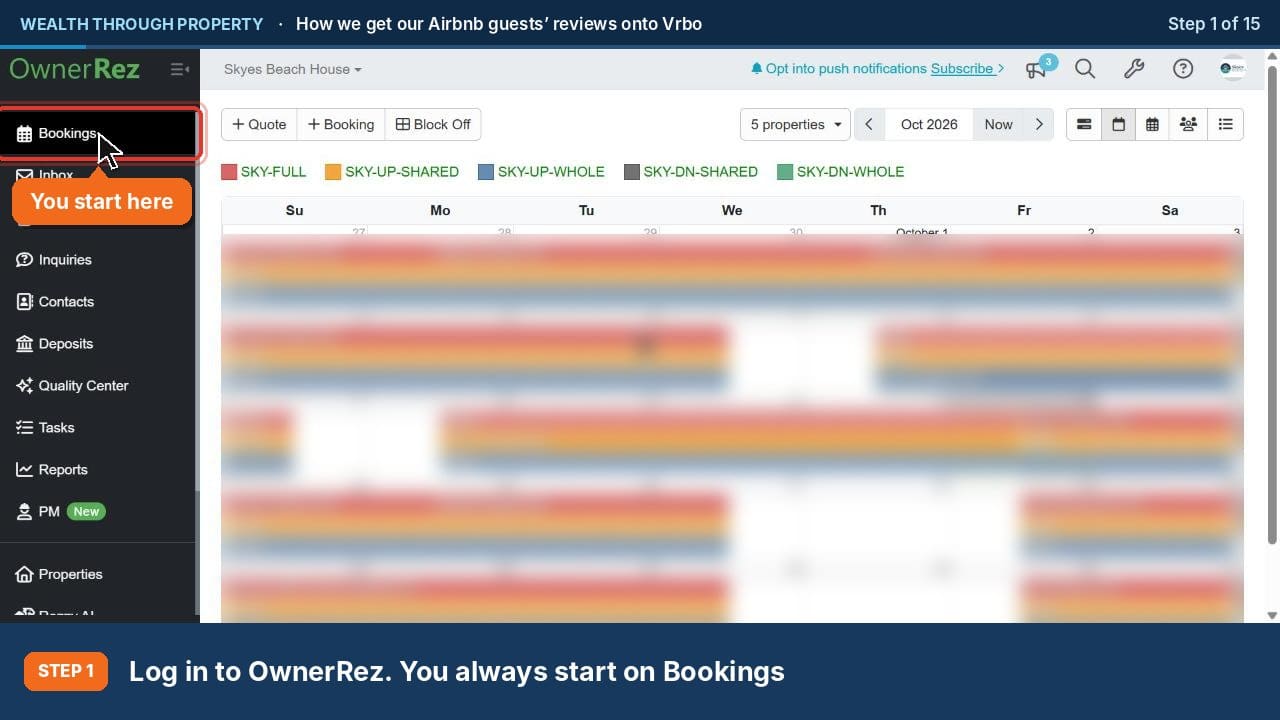 ▶Free lesson · IntroductionFree Lesson: How We Get Our Airbnb Guests’ Reviews onto Vrbo (OwnerRez)Vrbo won’t import your Airbnb reviews, but it does accept reviews that guests leave on your own OwnerRez review form. Ask every Airbnb guest to review…