Airbnb Bans Guest Checkout Chores From 20 November: What Hosts Should Do
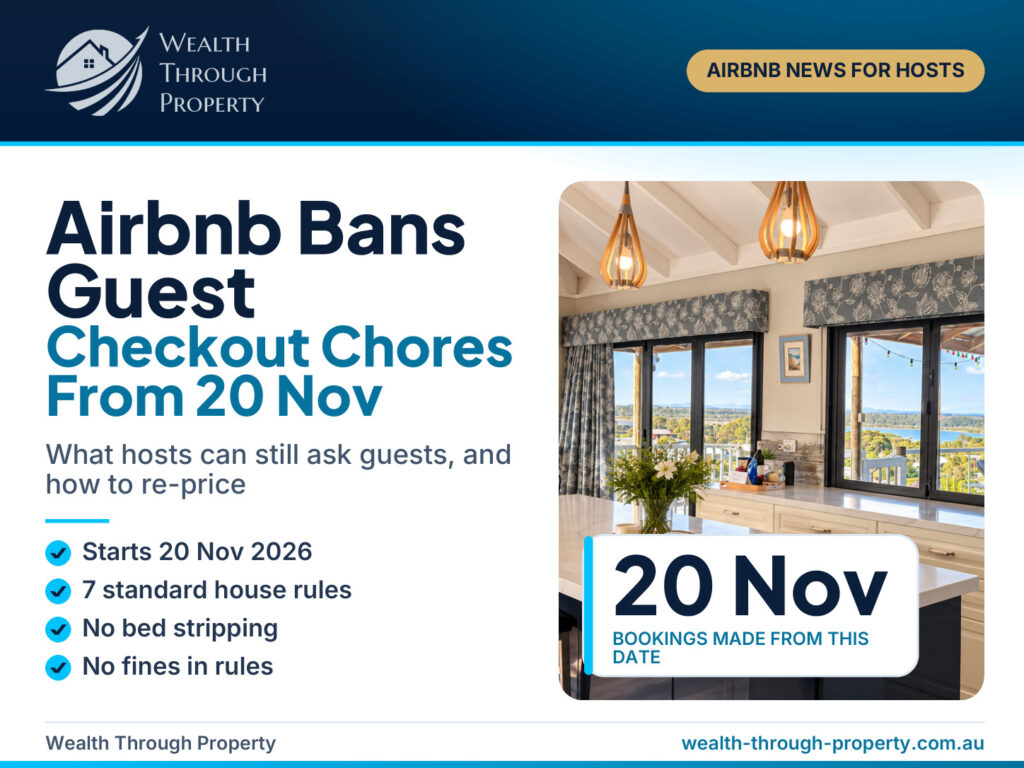
Airbnb has rewritten its house rules. For every reservation booked on or after 20 November 2026, Australian hosts generally can no longer ask guests to strip beds, wash and put away dishes or take rubbish off-site, and house rules cannot include fines. Hosts now pick from 7 standard rules and add "reasonable requests", such as putting used dishes in the sink. Here is what changed, why, what it costs, and what to do before 20 November.
SLScott LevouneFounder, Wealth Through PropertyUpdated 30 Oct 2026•19 min read•✓ Facts checked against official sources
Airbnb's new Reasonable House Rules and requests policy applies to reservations booked on or after 20 November 2026. Hosts can set 7 standard rules and add reasonable requests, but generally cannot ask for cleaner-style chores, restrict advertised amenities or fine guests. In our view, for most hosts the real impact is a slightly longer clean at each turnover: a pricing decision, not a reason to quit.
Before 20 November 2026
Five things every Airbnb host in Australia should do this fortnight.
1Open the Listing editor: Review House Rules and requests and fix anything Airbnb highlights.
2Cut the chore list: Remove stripping beds, washing dishes, laundry and taking rubbish off-site.
3Delete fines: Replace "$500 fine" wording with a clear rule and a notice of any strata or council fines.
4Re-scope the clean: Agree the extra minutes and cost per turnover with your cleaner in writing.
5Re-price once: Decide whether the extra cost goes into the cleaning fee, the nightly rate or your margin.
Dates To Know
20 October 2026: Airbnb published the change. 20 November 2026: the policy applies to reservations booked on or after this date. Earlier bookings, even for January stays, stay under the old rules. Facts checked 28 October 2026.
What Airbnb Changed In Its House Rules
On 20 October 2026 Airbnb published "Important changes to House Rules" in its Resource Centre and a new community policy called Reasonable House Rules and requests. The policy page states: "This policy applies to all reservations booked on or after November 20, 2026."
The house rules screen has been rebuilt: Airbnb says hosts can now "choose from 7 standard rules and add reasonable requests, all in one place in the Listing editor", and checkout instructions "no longer appear in a separate tab".
The policy separates two kinds of instruction. A house rule is binding: Airbnb says guests "must follow hosts' house rules". A request is not binding in the same way: guests "are encouraged to comply with hosts' requests". That distinction decides what you can enforce later.
Standard house rulesSeven set areas, chosen in the Listing editor. Guests must follow them, and Airbnb can enforce them.
Reasonable requestsYour own extra instructions for the stay and checkout. They must pass Airbnb's reasonableness test.
Not allowedCleaner-style chores, blocking advertised amenities, and fines or penalties written into the rules.
The contracts and guest ID part of the same 20 November update is covered in our separate guide, Airbnb rental agreement and guest ID ban. This article deals with house rules, checkout chores, fines and what they do to your costs.
The 7 Standard Airbnb House Rules
Airbnb's Resource Centre lists the 7 areas in which hosts can now set standard house rules. Two of them, maximum overnight guests and lock up at checkout, are described by Airbnb as new options.
Maximum overnight guests: match it to council approvals, insurance and strata limits.
Quiet hours: match your by-laws or local noise rules.
Events: whether events are allowed.
Pets: whether pets are allowed and how many.
Smoking: including vaping and e-cigarettes.
Commercial photography: whether filming for commercial use is allowed.
Lock up at checkout: with optional details on where to return keys.
Everything else goes under Requests, and every request must be reasonable. Your standard rules sit on top of Airbnb's guest ground rules, which every guest agrees to when they book.
If a rule matters enough that you would cancel a booking over it, it belongs in the 7 standard rules. If it is a preference, write it as a polite request.
What Airbnb Hosts Can And Cannot Ask Guests To Do At Checkout
Airbnb's policy says hosts are generally not allowed to "Ask guests to complete tasks that require significant effort or time, or would typically be performed by a cleaner, including stripping the bed, taking trash offsite, or washing and putting away dishes." The Resource Centre gives paired examples of what is and is not generally allowed. The table below sets them out, with WTP's notes for Australian homes.
Area
Generally allowed (Airbnb example)
Generally not allowed (Airbnb example)
WTP note for Australian listings
Dishes
Put used dishes in the sink
Wash and put away dishes
Running the dishwasher is not named. Test it as a request.
Laundry
Gather used towels
Remove sheets from the bed or start a load of laundry
Bed stripping moves to your cleaner.
Rubbish
Separate rubbish and recycling into designated indoor bins
Take rubbish off-site
Kerbside bin night is not named. Make it a cleaner task.
Utilities
Turn off air conditioning when leaving
Avoid using a listed amenity such as air conditioning
Do not advertise a heated pool or air con, then restrict it.
Fees
Information about optional add-ons, such as breakfast
Separate fees for an advertised part of the listing
Any fee for an advertised feature must be included in the price shown at booking.
Penalties
Notice that a strata body or council may impose a fine
Fines or other penalties set by the host
Delete fine wording. Keep the rule.
Airbnb says it considers context, giving drought-related shower limits and animal-proof bins as examples of requests that may be reasonable.
The ground rules for guests add one more line that hosts should read closely: "Hosts may not charge guest fees for failing to perform specific cleaning or checkout tasks, but they may leave ratings and reviews based on cleanliness."
Why Airbnb Changed The House Rules
Airbnb's statement, reported by the ABC on 22 October 2026, was: "House rules help guests understand what hosts expect, but we've heard from our community that they can be confusing, onerous and hard to manage," and "So we've redesigned them to make them easier to discover and clearer to set, alongside a new policy that keeps requests reasonable, with no surprises."
The change follows guest complaints. The ABC reported complaints from some travellers about cleaning fees, "which can cost hundreds of dollars", on top of a chore list before leaving. Airbnb's own guest ground rules now say cleaning fees set by hosts are meant to cover the cost of standard cleaning between reservations, such as laundry and vacuuming. In other words, Airbnb has drawn a line between the cleaning a guest pays for and the cleaning a guest does.
It also fits a longer trend. Airbnb says it is transitioning all home hosts to a single service fee, and the cleaning fee is part of the total price guests see. Our reading is that a guest who sees one total and then a long checkout list feels the price has gone up, and that Airbnb expects clearer rules to lift guest confidence, even if some hosts lose a little margin.
What the policy does not change
Guests are still expected to leave the home in a reasonable state. Airbnb's ground rules say guests should not leave a listing needing "excessive or deep cleaning" and are expected to pay reasonable requests for reimbursement for damage, missing items or unexpected cleaning costs. Cleaning fees are not abolished, and hosts still set check-in and checkout times.
How Australian Hosts Have Reacted
The reaction has been loud, in Australia and overseas. The ABC reported on 24 October 2026 that the change had sparked an outcry among hosts around the world, with online petitions launched against the new rules and some hosts planning a "nationwide host blackout" on 20 November by closing their properties to bookings on that day. Closer to home, a Townsville host with three listings told the ABC the change was "infuriating" and that many hosts would "have to increase their prices and then pay someone else to do the whole cleaning".
Others were more measured. Felicity Stevens, who leads Airbnb's Sydney host club, a network of about 800 members, told the ABC: "I don't think it's too much to be able to ask a guest to put the dishwasher on before you leave and to put the rubbish out," while also saying some hosts had gone "too far" with checkout demands.
Our view at WTP: a blackout day can cost a host the bookings that would have come in that day, and it does not change the policy. The practical response is to update the listing calmly, protect reviews and price the extra cleaning time properly.
Fines, Damage And Smoking: What Replaces The "$500 Fine" Rule
Many listings carry lines such as "$500 fine for parties". Under the new policy, hosts are generally not allowed to "Impose fines or other penalties on guests." The policy points hosts to AirCover instead, which it says "provides protection for hosts in the rare event that their place or belongings are damaged by a guest during an Airbnb stay." The tools now look like this:
A clear standard ruleNo events, no smoking, maximum guests. Guests must follow these, and Airbnb can act on breaches.
Cancellation without penaltyAirbnb says hosts can cancel without fees if a guest breaks a House Rule during the stay or says before check-in they intend to.
Reimbursement for real costsGuests are expected to pay for damage, missing items or unexpected cleaning. Request it through the Resolution Centre with evidence.
Notice of third-party finesIf a strata body, building or council may fine for a breach, say so in the designated section of the listing.
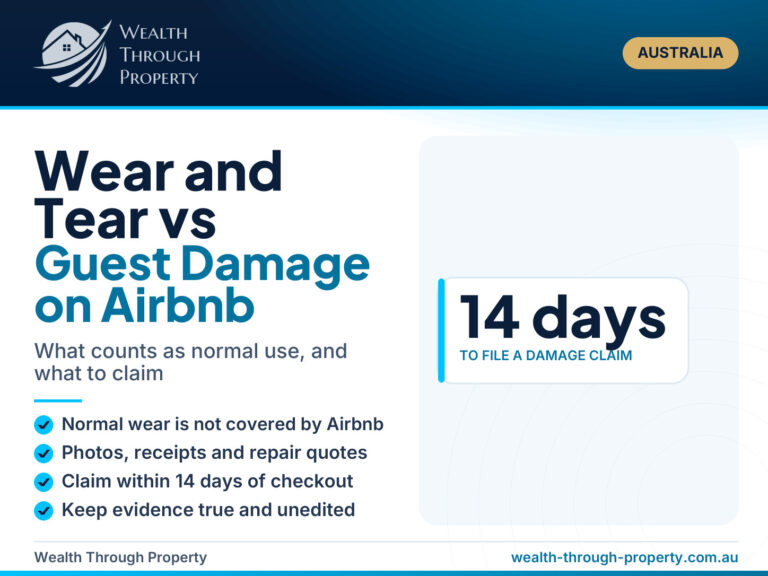
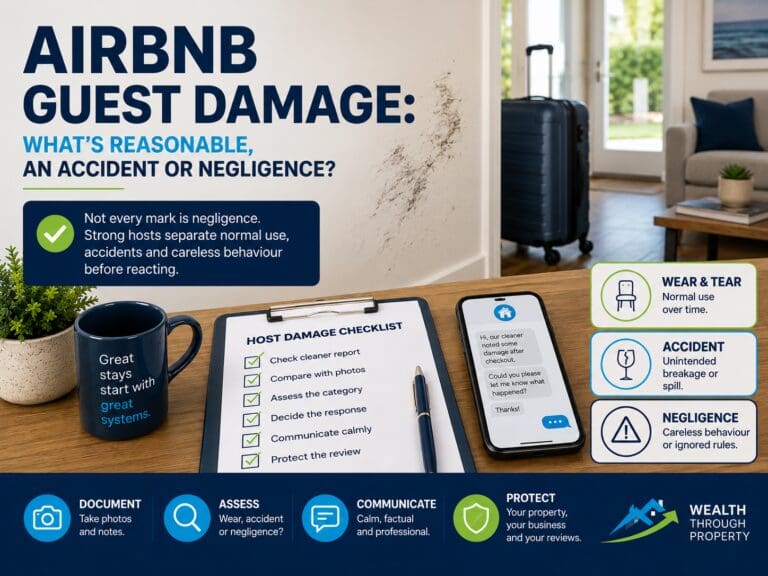
A flat fine is a penalty. A smoke-damaged couch that needs professional cleaning is a cost with an invoice, and turnover photos plus a timestamped cleaner report make that claim easier. Our guide to Airbnb wear and tear versus guest damage covers what is reasonable to claim.
Strata By-Laws, NSW Rules And Local Requirements
Australian hosts have obligations that sit outside Airbnb. In New South Wales, the NSW Government's host obligations page says "A host must provide the following information", which includes "an electronic or hard copy of the Code of Conduct" and "by-laws that apply to the premises, common or association property if the premises are within a strata scheme or community land scheme." It also says "The host must take reasonable steps to ensure that guests comply with their obligations under the Code."
Airbnb's policy wants rules and requests in the listing's designated section at booking, not added later by message, signs or in person. The sensible way to satisfy both is to put the substance in the listing and keep sending what the law requires:
1Summarise the by-laws in the listing: Quiet hours, pool hours, parking bays and visitor limits belong in House Rules and requests.
2Keep the legal documents flowing: NSW hosts still provide the Code of Conduct and by-laws as required.
3Give notice of building fines: If the owners corporation can fine for a breach, say so in the listing's designated section.
Rules differ by state and council. See our Airbnb rules by state guide and, for apartments, strata rules for Airbnb. Confirm the current position with your council, your state's short-term rental register and your strata manager.
What It Costs: A Worked Example For A Holiday House
The cost is the extra time your cleaner spends on tasks guests used to do. The figures below are illustrative, not a quote, average or forecast.
Assumption (illustrative)
Figure
Property
3-bedroom coastal holiday house
Cleaner rate
$55 an hour
Extra time per turnover after 20 November
30 minutes
Extra cost per turnover
$27.50
Turnovers a year
80
Average stay
3 nights (240 booked nights, about 66% occupancy)
Average nightly rate
$280
Airbnb service fee (single fee, most hosts)
15.5%, deducted from payout
On those assumptions the extra cleaning costs $27.50 x 80 = $2,200 a year. Nightly income before fees is $280 x 240 = $67,200, so the extra cleaning is about 3.3% of nightly income.
Because Airbnb's 15.5% fee comes off what the guest pays, a host who wants to recover $27.50 a stay needs to add more than $27.50. $27.50 divided by 0.845 is about $32.54, so the example rounds up to $33.
Option (illustrative)
What the guest sees
Extra to host after 15.5% fee, per year
Versus $2,200 extra cleaning
A. Absorb the cost
No change
$0
-$2,200
B. Add $33 to the cleaning fee
$33 more per stay
$33 x 80 x 0.845 = $2,230.80
+$30.80
C. Add $11 a night
$33 more on a 3-night stay
$11 x 240 x 0.845 = $2,230.80
+$30.80
Options B and C recover the same money on a 3-night stay. A higher cleaning fee hits 1 and 2 night guests hardest; a higher nightly rate is fairer to short stays but collects more from long ones. Some hosts will use a mix, with dynamic pricing recovering the rest in peak weeks.
The honest framing: the work has not disappeared, it has moved from the guest to the cleaner. Price the cleaner's time and the policy stops being a problem.
Should You Raise Your Airbnb Cleaning Fee?
Not automatically. If your cleaner already re-washes dishes and checks every bed anyway, the real extra time may be smaller than you fear.
1Ask your cleaner for real minutes: Time three turnovers after 20 November rather than guessing.
2Check short-stay share: If most bookings are 2 nights, lean on the nightly rate rather than the cleaning fee.
3Compare total prices: Look at the full guest total for 2 nights against your nearest competitors, not the nightly rate alone.
4Review after 4 weeks: Watch conversion, reviews and pace, then adjust once.
How To Rewrite Your House Rules And Requests, Step By Step
Airbnb says non-compliant requests "will be highlighted in the Listing editor", with an email, tips and a chance to appeal. If an issue is left unresolved, "Guests may see an alert on your listing, such as 'includes cleaning requests'". That alert is the real risk: a listing that looks fussy can lose clicks.
Copy your current rules and checkout list. You will use the old wording to brief your cleaner.
Set the 7 standard rules first. Maximum overnight guests, quiet hours, events, pets, smoking, commercial photography and lock up at checkout.
Sort everything else into three piles. Keep as a reasonable request, move to the cleaner's scope, or delete.
Rewrite requests in plain, friendly language. "Please pop used dishes in the sink and gather used towels in the bathroom" reads better than a numbered list of demands.
Give the reason for any unusual request. Water restrictions, septic systems, tank water or wildlife-proof bins are the kind of local context Airbnb says it considers.
Remove fines and penalties. Keep the rule. Add notice of any strata or council fine where relevant.
Check every advertised amenity. If the pool, spa, fireplace or air con is in the listing, guests can use it, and any fee for it must be in the price shown at booking.
Delete rules from other places. Airbnb says rules should not be written elsewhere on the listing, in messages or on signs in the home. Move house manual content that reads like a rule into the listing.
Save and look for highlights. Fix anything flagged, or appeal with your local reason.
Update your automated messages. Scheduled checkout messages should no longer ask for chores.
Your digital guidebook still matters for how-to information. Our digital house manual guide shows how to keep it useful without turning it into a second set of rules.
A Reasonable Checkout Message Example
Here is an example of checkout wording that stays inside Airbnb's examples. Adjust it to your home and check how the Listing editor treats it.
Example request wording (illustrative)
Thanks for staying with us. Before you head off, please: put used dishes in the sink, gather used towels in the bathroom, sort rubbish and recycling into the indoor bins, switch off the air conditioning and lights, and lock up and return the key to the lockbox. Our cleaning team takes care of everything else. Safe travels.
Notice what is missing: no bed stripping, no washing up, no laundry, no wheelie bins and no penalties. A two-minute checkout is the point of the policy, and it is good hospitality.
Briefing Your Cleaner For The New Turnover
The change lands hardest on your cleaning team. If they expect stripped beds and a clean kitchen and find neither, turnovers run late. Brief them before the first booking made on or after 20 November checks in.
New tasks in scopeStripping all beds, washing or loading remaining dishes, emptying bins and handling bin night.
Time and priceAgree the extra minutes and the new rate in writing, per property type.
Damage reportingPhotos of excessive mess or damage, timestamped, sent the same day so a claim can be made.
Same-day turnoversCheck the checkout and check-in times still leave enough time on tight changeover days.
Does This Change The Airbnb Versus Long-Term Rental Decision?
For investors weighing up an Airbnb against a standard lease, the honest answer is: slightly, and not enough to flip a good property. Long-term rentals are a sound investment with low workload, and nothing in this policy changes that. A well-chosen, well-run short-term rental can still earn materially more from the same home, and the owner keeps control of pricing, length of stay and personal use.
In the illustrative house above, the extra cleaning is about 3.3% of nightly income, and close to neutral once priced in. What the policy rewards is operation: hosts with a short checkout and a professional cleaning team change very little, while hosts who relied on guests to do part of the clean now carry that cost.
Also check how your manager is paid. Many managers charge a percentage of the full booking. If the cleaning fee rises by $33 across 80 stays, a generic manager taking 20% of the full booking (an illustrative figure, not a quote) would collect an extra $528 a year on money that goes straight to the cleaner. WTP's full management fee is worked out on what the home earns after platform fees and cleaning, so cleaning costs are not part of the base.
This article is general information. It does not consider your objectives, financial situation or needs. Before acting, get advice from a licensed financial adviser, a registered tax agent, a solicitor and, for any lending, a licensed mortgage broker or lender. Worked examples use illustrative figures and are not a forecast of any property's income or costs.
How WTP Helps Hosts Through Airbnb Policy Changes
Wealth Through Property helps clients buy, set up, optimise and manage Airbnb homes across Australia, and keeps the listings it manages up to date when Airbnb changes its policies.
Full-Service Airbnb Management
We run the listing, house rules, pricing, guests, cleaners and reviews, with the listing kept in your name. $340 a month flat for the first three months, then 12.5% falling to 3% of what the home earns after platform fees and cleaning, GST included.
For hosts who run their own home: daily pricing, listing fixes and monthly results. $150 a month for one listing for the first 3 months, then $250 a month, GST included.
Want Your House Rules And Pricing Checked Before 20 November?
Book a short call with the WTP team. Bring your listing link and your cleaner's rate, and we will talk through which rules to keep, which to move to your cleaner and how to price the change.
From 20 November 2026, hosts choose from 7 standard rules: maximum overnight guests, quiet hours, events, pets, smoking, commercial photography and lock up at checkout. Anything else goes under Requests and must be reasonable. Hosts generally cannot ask for cleaner-style chores, block advertised amenities or set fines for guests.
When do Airbnb's new house rules start?
Airbnb's policy applies to all reservations booked on or after 20 November 2026. A booking made before that date stays under the previous policy, even if the stay is in December or January. Airbnb launched the new House Rules screen and announced the change on 20 October 2026, so hosts can update their listings now.
Can Airbnb hosts still make guests strip the beds?
No, not for bookings made on or after 20 November 2026. Airbnb lists stripping the bed and starting laundry as tasks hosts generally cannot ask for. Hosts can ask guests to gather used towels. Bed stripping now belongs in the cleaner's scope, so allow extra minutes per turnover and agree the cost with your cleaner.
Can I ask Airbnb guests to wash the dishes?
Airbnb says guests should not be asked to wash and put away dishes, but hosts can ask them to put used dishes in the sink. Running the dishwasher is not named in Airbnb's examples, so write it as a polite request and check whether the Listing editor highlights it before relying on it.
Can Airbnb hosts ask guests to take the bins out?
Hosts can ask guests to separate rubbish and recycling into designated indoor bins. Airbnb says hosts generally cannot ask guests to take rubbish off-site. Wheeling council bins to the kerb is not named either way, so the safer approach is to make bin night part of the cleaner's or a local helper's job.
Can Airbnb hosts still charge a cleaning fee?
Yes. Cleaning fees are not abolished. Airbnb's guest ground rules say cleaning fees cover standard cleaning between reservations, and hosts may not charge guests extra fees for failing to do cleaning or checkout tasks. Guests are still expected to reimburse unexpected cleaning costs, damage or missing items through Airbnb's process.
Can Airbnb hosts fine guests for breaking house rules?
No. The new policy says hosts generally cannot impose fines or other penalties on guests. Hosts can cancel without fees if a guest breaks a House Rule, request reimbursement for real damage or cleaning costs, leave an honest review, and give notice in the listing of fines a strata body or council may impose.
Are Airbnb house rules legally binding on guests?
Airbnb says guests must follow hosts' house rules and agree to its ground rules when they book, and Airbnb can act on repeated or severe breaches. Requests are different: guests are encouraged, not required, to follow them. Whether a rule is enforceable in an Australian court is a legal question, so get legal advice for disputes.
Show 4 more questionsShow fewer questionsWhat happens if my Airbnb listing breaks the new policy?
Airbnb says non-compliant requests are highlighted in the Listing editor, with an email, tips and a chance to appeal. If an issue is not fixed, guests may see an alert such as "includes cleaning requests". Persistent breaches can lead to a listing notice, reduced visibility in search, or other action under Airbnb's terms.
Should I raise my Airbnb cleaning fee because of the chores ban?
Time your cleaner's extra minutes first. In WTP's illustrative example, 30 extra minutes at $55 an hour costs $27.50 a turnover, and recovering it after Airbnb's 15.5% fee needs about $33 more per stay. For short stays, adding to the nightly rate is often fairer than a higher cleaning fee.
Do NSW strata by-laws still need to be given to Airbnb guests?
Yes. The NSW Government says hosts must provide guests with the Code of Conduct and any by-laws that apply if the home is in a strata or community scheme. Put the key by-laws, such as quiet hours and pool times, in your Airbnb House Rules and requests so guests see them before booking.
Should Australian hosts leave Airbnb over the new house rules?
For most hosts, no. In WTP's illustrative example the extra cleaning is about 3.3% of nightly income and can be priced in. A better response is to rewrite your rules, re-scope your cleaner, price the change once and add other channels over time, rather than closing your calendar in protest.
SL
About the author
Scott Levoune
Founder of Wealth Through Property. Scott built a portfolio of 10 investment properties in 3 years, then built the pricing system that turned his own Airbnb into one of the top earners on the NSW South Coast. He and the team now buy, set up and manage short-stay homes across Australia.