5% Deposit Scheme 2026: Buy Your First Home With 5% and No LMI
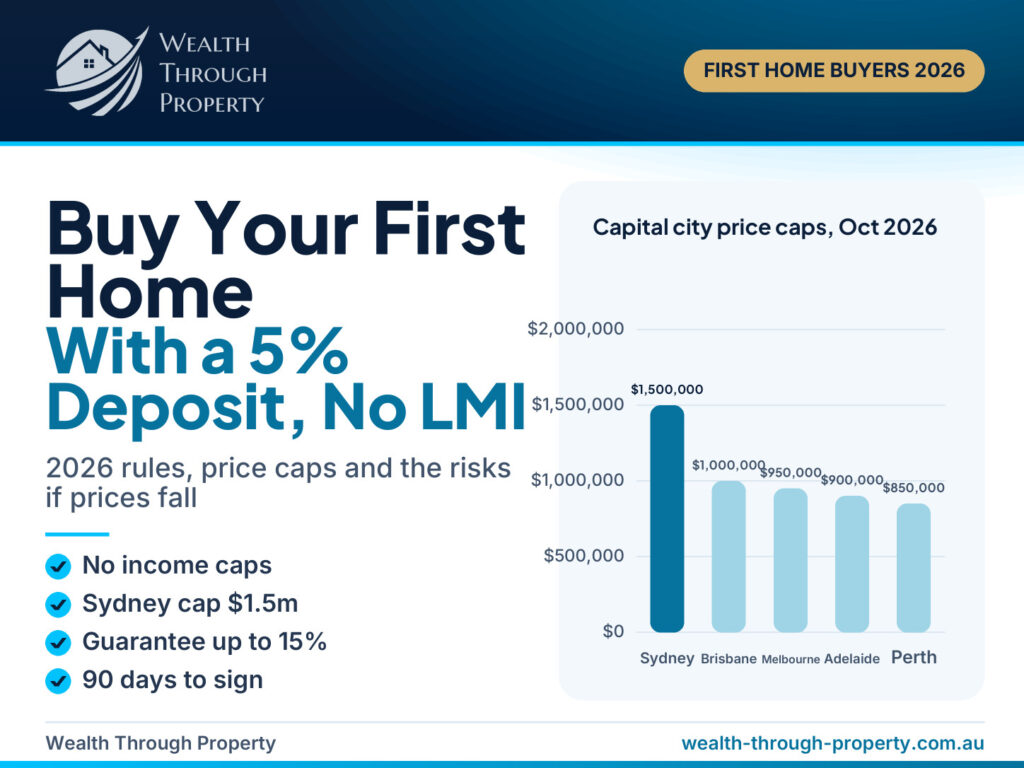
The Australian Government 5% Deposit Scheme lets an eligible first home buyer purchase with a deposit of 5% of the property's value (2% for eligible single parents) without paying lenders mortgage insurance, because Housing Australia guarantees up to 15% of the value to your lender. Since 1 October 2025 there are no income caps and no waitlists, but the home must sit under a price cap for its location (for example $1.5 million in Sydney and $950,000 in Melbourne), you must live in it, and you apply through a participating lender. With prices easing in many markets in 2026, this guide explains the rules, the real costs and the risks before you sign anything.
SLScott LevouneFounder, Wealth Through PropertyUpdated 28 Oct 2026•18 min read•✓ Facts checked against official sources
5% Deposit Scheme 2026: Buy Your First Home With 5% and No LMI.5m Sydney" loading="eager" decoding="async" fetchpriority="high" sizes="(max-width: 1080px) calc(100vw - 36px), 1080px" srcset="https://wealth-through-property.com.au/wp-content/uploads/2026/10/5-deposit-scheme-first-home-buyers-2026-wtp-cover-fa7ab8e-1024x768.jpg 1024w, https://wealth-through-property.com.au/wp-content/uploads/2026/10/5-deposit-scheme-first-home-buyers-2026-wtp-cover-fa7ab8e-300x225.jpg 300w, https://wealth-through-property.com.au/wp-content/uploads/2026/10/5-deposit-scheme-first-home-buyers-2026-wtp-cover-fa7ab8e-768x576.jpg 768w, https://wealth-through-property.com.au/wp-content/uploads/2026/10/5-deposit-scheme-first-home-buyers-2026-wtp-cover-fa7ab8e.jpg 1448w" />
The 5% Deposit Scheme can bring your purchase forward by years and saves the LMI premium, which the Government estimates at around $23,700 on a national median-priced home. In exchange you carry a larger loan, pay more interest and have less equity if values fall. Treat it as a tool, not a reason to buy.
Before You Apply
Five checks that decide whether the scheme suits you.
1You qualify: Citizen or permanent resident, 18 or over, and no property interest in Australia in the last 10 years.
2Your deposit fits: At least 5% of the property value, but less than 20% once stamp duty and legal costs are paid.
3The home fits: Both the price and the lender's valuation are at or under the cap for that postcode.
4You will live there: Move in within 6 months of settlement and keep living there while the guarantee applies.
5You can carry the loan: Repayments still work if rates rise or the home is worth less for a few years.
Key Numbers
5% minimum deposit for first home buyers, 2% for single parents. 15% maximum guarantee (18% for single parents). 90 days to sign a contract after pre-approval. 30 years maximum loan term (plus up to 3 years to build). 102,594 buyers used the expanded scheme in its first year, according to Treasury.
What Is the 5% Deposit Scheme?
The Australian Government 5% Deposit Scheme is run by Housing Australia. It was formerly known as the Home Guarantee Scheme, and many people still search for it as the First Home Guarantee, the First Home Guarantee Scheme or the 5 percent deposit scheme.
Normally a lender wants a 20% deposit. If you borrow more than 80% of a home's value, the lender usually charges lenders mortgage insurance (LMI), a one-off premium that protects the lender, not you. Under the scheme, Housing Australia gives your lender a guarantee instead, so you can borrow up to 95% of the value without paying LMI.
Housing Australia's Information Guide (dated 1 July 2026) is blunt: "A Guarantee protects the Participating Lender, not you." If you default and the sale does not cover the debt, the guarantee pays the lender a shortfall up to a pre-agreed limit of up to 15% of the property value. You remain responsible for the loan.
What you getA home loan of up to 95% of the property value (98% for eligible single parents) with no LMI premium.
What you do not getCash, a grant, a lower interest rate by default or protection if you fall behind on repayments.
Who runs itHousing Australia, through more than 30 authorised participating banks, mutuals and other lenders.
What Changed on 1 October 2025, and What It Means Now
The official First Home Buyers website says: "From 1 October 2025, the changes to the Scheme meant no income caps, no waitlists and no Lenders Mortgage Insurance." Treasury describes the October 2025 expansion as "removing income caps, uncapping the number of places and increasing property price limits".
A Treasury media release dated 1 October 2026 says Housing Australia data shows 102,594 first home buyers used the expanded scheme in its first year, and more than 280,000 Australians have been supported since 2022. The same release estimates the LMI saving at "around $23,700" for a first home buyer purchasing the national median-priced home with a 5% deposit.
The RBA lifted the cash rate to 4.60% at its September 2026 meeting, and its October 2026 Financial Stability Review says: "Housing prices have declined in recent months as housing market sentiment has weakened, reflecting the somewhat restrictive stance of monetary policy and changes to negative gearing and capital gains tax discount policies." That is why the negative equity headlines of October 2026 matter. For what the rate rise means for repayments, read our explainer on the RBA rate rise to 4.60%.
5% Deposit Scheme Eligibility: Who Can Use It
Your lender checks these rules, and you sign a Home Buyer Declaration, a Commonwealth statutory declaration. A false declaration can lead to criminal penalties.
1Citizenship: You (both of you, if buying jointly) must be an Australian citizen or permanent resident on the date you sign the home loan.
2Age: At least 18 years old on the home loan date.
3Prior ownership: A first home buyer, or no interest in Australian property (including land, investment or commercial property) in the 10 years before the home loan date.
4Deposit: At least 5% of the property value saved, and less than 20% after paying purchase costs such as stamp duty and legal fees.
5Owner-occupier: You buy or build a home to live in. Investment properties are not eligible.
6Applicants: One person, or two people jointly (partners, friends or family). Loans with three or more borrowers do not qualify.
The 10-year rule means a previous owner can use the scheme again once a decade has passed. The guide also says you must use as much of your savings as possible for the deposit; moving money to someone else to stay under 20% goes against the intent of the scheme.
Single parents and single legal guardians of at least one dependent child apply under the single-parent version, with a 2% minimum deposit and a guarantee of up to 18%. Housing Australia's separate guide says that if you qualify as both a first home buyer and a single parent, you must apply as a single parent, and that version requires that you do not currently own property rather than the 10-year test.
5% Deposit Scheme Price Caps by State in 2026
Both the purchase price and your lender's valuation must be at or below the cap; for land plus a separate build, the combined cost must fit. Caps from the First Home Buyers website and the 1 July 2026 Information Guide, checked 28 October 2026:
State or territory
Capital city and regional centres
Rest of state
New South Wales
$1,500,000
$800,000
Victoria
$950,000
$650,000
Queensland
$1,000,000
$700,000
Western Australia
$850,000
$600,000
South Australia
$900,000
$500,000
Tasmania
$700,000
$550,000
Australian Capital Territory
$1,000,000 (all areas)
Not applicable
Northern Territory
$750,000 (Darwin)
$600,000
Jervis Bay Territory and Norfolk Island
$550,000 (all areas)
Not applicable
Christmas Island and Cocos (Keeling) Islands
$400,000 (all areas)
Not applicable
The "regional centres" that share the higher cap are, in NSW, the Central Coast, Coffs Harbour–Grafton, Illawarra, Mid North Coast, Richmond–Tweed, and Newcastle and Lake Macquarie; in Victoria, Geelong; and in Queensland, the Gold Coast and Sunshine Coast. Some suburbs span more than one postcode with different caps, so use the official postcode search tool and confirm the cap with your lender before you bid.
The valuation trap near the cap
If you pay $949,000 for a Melbourne home and the bank values it at $930,000, the scheme uses the lender's assessed value, so Housing Australia's guide says you may need to contribute a higher deposit or accept a smaller loan. If a contract price goes over the cap, the home is not eligible at all. Our guide to bank valuations and overpaying explains how this happens.
What Property You Can Buy Under the Scheme
The scheme covers new or existing houses, townhouses and apartments, house and land packages, off-the-plan purchases, and vacant land with a separate building contract. Owner-builder contracts are not eligible, and land you already owned before securing a place does not qualify.
Existing homeMove in within 6 months of your home loan settlement date.
House and land or land plus buildBuilding contract within 6 months, start within 12 months and finish within 36 months of settlement, then move in within 6 months of the occupancy certificate.
Off the planSign before loan settlement, settle within 90 days of the home loan date and move in within 6 months of settlement.
A building contract must be with a licensed and registered builder, insured, at arm's length and fixed price. Delays, cost increases and builder insolvency are not covered by the guarantee.
How the 5% Deposit Scheme Works, Step by Step
You cannot apply to Housing Australia directly. Everything runs through a participating lender or one of its authorised representatives.
Check eligibility. Use the tool on firsthomebuyers.gov.au.
Talk to a participating lender. The lender assesses you, then reserves a guarantee place with Housing Australia. That place is held for 14 days while you complete the application.
Complete the application. Provide proof of citizenship or residency, your Medicare number and the Home Buyer Declaration.
Search within 90 days. Once your place is pre-approved you have 90 days to find a home and sign a contract. Your loan still needs the lender's own credit approval.
Settle and move in. The lender manages final approval. You then meet the ongoing owner-occupier rules.
You may apply with more than one participating lender, but must choose one before you sign a contract. Compare full loan costs, not headline rates. Pre-approval basics are covered in our guide to home loan pre-approval.
Ninety days goes quickly. Have your brief, budget and inspection plan ready before the clock starts.
How Much Deposit Do You Need to Buy a House?
So how much deposit to buy a house? Lenders usually want 20% to avoid LMI. With 10% you can usually borrow but will normally pay LMI. With 5%, a scheme-backed 5% deposit home loan is the main way to avoid LMI if you are eligible. On top of the deposit you need stamp duty (unless a concession covers it), conveyancing, inspections, lender fees and a buffer.
Deposit on a $700,000 home (illustrative)
Cash for deposit
Loan
LMI?
5% with the scheme
$35,000
$665,000
No LMI if eligible
5% without the scheme
$35,000
$665,000
Usually yes, if a lender will lend
10%
$70,000
$630,000
Usually yes
20%
$140,000
$560,000
Usually no
There is an upper limit too: with 20% or more saved after purchase costs, your loan is not eligible for the scheme.
Worked Example: A $700,000 First Home in Brisbane
Every figure here is illustrative, including the 6.9% interest rate, which is not a quote from any lender.
Mia is buying a $700,000 established house in Brisbane to live in, under the $1,000,000 Brisbane cap. Queensland's first home concession reduces transfer duty to nil at this price: the Queensland Revenue Office home concession rate gives $17,350 of duty on $700,000, and the first home concession amount for homes up to $709,999.99 is also $17,350.
Item (illustrative)
5% with the scheme
20% deposit
Deposit
$35,000
$140,000
Transfer duty with QLD first home concession
$0
$0
Legal, inspection and lender costs (allowance)
$4,000
$4,000
Cash needed at settlement
$39,000
$144,000
Loan amount
$665,000
$560,000
Monthly repayment, 30 years at 6.9%
$4,379.69
$3,688.16
Total interest over 30 years
$911,689
$767,738
The 5% route costs Mia about $691.53 more a month and about $143,951 more interest over 30 years if the rate never changed. In return she skips saving another $105,000. Saving that gap at $1,500 a month would take 70 months, almost six years, and Treasury notes some purchasers save for up to 11 years. Whether buying now is better depends on what prices and rents do in those years, which nobody can promise.
On scheduled repayments alone, Mia's balance would take about 129 months, close to 11 years, to fall to $560,000, the 80% point where the guarantee ends. Treasury says most people move off the scheme in 2.5 years on average, but the release does not say how, so ask your lender what would end your guarantee and what that would cost.
Is the 5% Deposit Scheme Risky If House Prices Fall?
This was the question in the news in October 2026. Housing Australia's own guide lists the small-deposit risks: paying more interest, being more affected by rate rises, having less equity at the start, and owing more than the property is worth if its value falls.
Mia's illustrative balance after 12 months is about $658,114. If her home's value fell that year, her equity would look like this (selling costs an illustrative 2.5%).
Value change after 12 months (illustrative)
Home value
Equity before selling costs
Equity after 2.5% selling costs
Down 5%
$665,000
$6,886
-$9,739
Down 10%
$630,000
-$28,114
-$43,864
Down 15%
$595,000
-$63,114
-$77,989
Negative equity bites when you have to sell or refinance, not while you can keep paying and stay put. The RBA's October 2026 Financial Stability Review says "Recent buyers and those who took out higher LVR loans are more likely to be in negative equity. This includes first home buyers participating in the Australian Government 5% Deposit Scheme." It also says hardship or arrears for scheme participants "remain contained", and that participants were assessed at interest rates 3 percentage points above their offered rate under APRA's serviceability buffer.
What protects you in a soft market
A price justified by recent comparable sales, a matching valuation, a home you will live in for years, an emergency fund, and repayments stress-tested at a higher rate.
Stamp Duty and First Home Concessions by State
The guide confirms the scheme does not stop you using state or territory programs, including first home buyer stamp duty concessions. These were the rules on each revenue office's site on 28 October 2026.
State
First home buyer duty relief (summary)
NSW
Full exemption for new or existing homes valued up to $800,000; concessional rate above $800,000 and below $1,000,000 (contracts from 1 July 2023).
VIC
No duty up to a dutiable value of $600,000; reduced duty from $600,001 to $750,000.
QLD
New homes: duty reduced to nil with no value cap for the home (contracts from 1 May 2025). Established homes: first home concession of up to $17,350, tapering to nil at $800,000.
WA
For transactions from 7 May 2026: no duty up to $600,000; $16.15 per $100 above $600,000, with an $800,000 limit.
ACT
Home Buyer Concession Scheme: from 1 July 2026 the income threshold and property value limit were removed, and eligible buyers are exempt. Buyers need no property interest in the last 5 years.
TAS
The established-home exemption up to $750,000 applied to settlements from 18 February 2024 to 30 June 2026. Check the State Revenue Office for what applies now.
SA
For contracts from 13 February 2025: full stamp duty relief regardless of value for new homes, off-the-plan apartments and vacant land to build on. Established homes are not covered.
NT
Check the Territory Revenue Office directly; we could not verify its first home pages for this update.
Each concession has its own residence rules and deadlines. NSW buyers can read our First Home Buyer NSW guide for the full process from deposit to settlement.
The Ongoing Rules: When the Guarantee Ends
Buying is not the end of the obligations. The guide says the guarantee stays in place until one of these happens:
You rent the property outConverting the home to a rental is not allowed while the guarantee applies.
You stop living thereWithout an exemption agreed with your lender, LMI or other costs may apply.
The balance reaches 80%Measured on scheduled repayments against the property value; redrawable extra repayments are not counted.
You borrow moreIncreasing the loan after settlement, for example for renovations, is not permitted under the scheme.
You refinance elsewhereMoving to another participating lender may keep the guarantee; moving to a non-participating lender ends it.
You sell or repayThe guarantee ends when the loan is repaid or the home is sold.
If it ends while your loan is above 80% of the value, the guide warns your lender "may impose Lenders Mortgage Insurance (LMI) or other costs in line with your lender's policies and loan conditions."
Can You Rent Out or Airbnb a Home Bought With 5%?
Not while the guarantee applies. Housing Australia's guide gives the example of James, who wants to move in with a partner and rent his place out: "Converting the property into a rental (i.e. investment property) is not allowed." Renting out the property is listed as an event that ends the guarantee. The guide does not separately deal with renting a room or hosting short stays, so get your participating lender's answer in writing before you list any part of the home on Airbnb or anywhere else.
That does not close the door on investing. A long-term rental is a solid investment, and a well-chosen, well-run Airbnb can earn materially more from the same property while the owner keeps control of pricing, length of stay and personal use. For most first home buyers the path is sequential: live in your first home, build equity, then use it for a separate investment set up properly from day one, with council and strata rules checked first.
Five Mistakes First Home Buyers Make With a 5% Deposit
1Budgeting to the cap, not to value: The cap says nothing about what a home is worth.
2Forgetting the other costs: Duty, conveyancing, inspections and moving can push your cash need well past 5%.
3Letting the 90 days rush you: A deadline makes "best and final" pressure, fake competing buyers and underquoted price guides far more effective. Decide your walk-away price before you inspect.
4Skipping due diligence: With little equity, a hidden defect hurts more. Get a building and pest inspection and, for units, a strata report.
5Not planning the next step: If you may move or rent the home within a few years, the owner-occupier rules may not suit you.
Questions to Ask Your Lender and Your Buyers Agent
Ask any participating lender, and any buyers agent (also called a buyers advocate), these questions.
Which loan products can I use under the scheme, and at what rate?
How will you value the property, and what happens if the valuation comes in under the contract price?
What would you charge if my guarantee ended while my loan is above 80%?
Buyers agent: how do you work out what a home is worth from comparable sales, not the advertised guide?
Buyers agent: do you take any commission, referral fee or kickback from developers or sellers?
How a Home Buyers Agent Helps a 5% Deposit Buyer
With a 5% deposit, overpay by 3% and most of your equity is gone on day one. That is the problem a home buyers agent solves: setting a brief that fits the price cap and your budget, searching listed and off-market homes, inspecting, pricing each home against recent sales, and negotiating or bidding for you, through to settlement.
WTP's home buyers agent fee is $12,000 (GST included) for homes up to $1 million, with a sliding scale above that. The retainer starts from $1,000 and comes off the fee, and you can pay at settlement or spread the fee (3 months interest-free, or 12, 24 or 36 months with interest after the first 3 months) so it does not reduce your deposit. Check the figures for your price range in the home buyers agent fee calculator, and compare agents using our buyers agent fees guide.
This article is general information only. It does not take your objectives, financial situation or needs into account. Get licensed financial, tax, legal and lending advice before you act, and confirm every rule with the official source, because scheme rules, caps and concessions change.
How WTP Helps First Home Buyers
Home Buyers Agent
Brief, search, inspections, pricing from comparable sales, negotiation and bidding through to settlement, with a fixed $12,000 fee (GST included) for homes up to $1 million.
It is an Australian Government program, run by Housing Australia, that lets eligible first home buyers buy with a 5% deposit, and eligible single parents with 2%, without paying lenders mortgage insurance. Housing Australia guarantees part of the loan to your participating lender. It was formerly called the Home Guarantee Scheme.
Is the First Home Guarantee the same as the 5% Deposit Scheme?
Yes, in practice. The First Home Guarantee was the first home buyer part of the Home Guarantee Scheme, and the official site says the Australian Government 5% Deposit Scheme "was formerly known as the Home Guarantee Scheme". Single parents and legal guardians use a single-parent version of the same scheme with a 2% minimum deposit.
Who is eligible for the 5% Deposit Scheme?
You must be an Australian citizen or permanent resident, at least 18, and either a first home buyer or someone with no Australian property interest in the last 10 years. You need at least a 5% deposit but under 20% after costs, and you must live in the home. One or two applicants can apply.
Are there income limits for the 5% Deposit Scheme?
No. Since 1 October 2025 there are no income caps and no waitlists, and Treasury says the number of places was uncapped. You still need to pass the participating lender's own credit and serviceability assessment, so your income, debts and living costs still decide how much you can borrow under the scheme.
What are the 5% Deposit Scheme price caps in 2026?
For capital cities and regional centres: NSW $1.5 million, Victoria $950,000, Queensland $1 million, WA $850,000, SA $900,000, Tasmania $700,000, ACT $1 million and Darwin $750,000. Rest-of-state caps are lower, from $500,000 in SA to $800,000 in NSW. Check your postcode on firsthomebuyers.gov.au before you buy.
How much deposit do I need for a house in Australia?
Lenders usually want 20% to avoid lenders mortgage insurance. Many lend with 10% or 5% if you pay LMI. Under the 5% Deposit Scheme, eligible buyers need 5% and pay no LMI. On a $700,000 home that is $35,000, plus stamp duty unless a concession applies, and legal, inspection and lender costs.
How much is LMI without the scheme?
It depends on the lender, insurer, loan size and deposit. As a guide, Treasury estimated in October 2026 that the scheme saves around $23,700 in LMI for a first home buyer purchasing the national median-priced home with a 5% deposit. Ask lenders for a written LMI quote to compare.
Is the 5% Deposit Scheme risky if prices fall?
It can be. With 5% equity, a small fall in value can leave you owing more than the home is worth, especially after selling costs. The RBA's October 2026 review says scheme participants are more likely to be in negative equity, though arrears remain contained. It matters most if you must sell early.
Show 4 more questionsShow fewer questionsCan I rent out or Airbnb my home bought under the scheme?
Not while the guarantee applies. Housing Australia's guide says converting the home into a rental is not allowed, and renting it out ends the guarantee, which may trigger LMI or other costs. The guide does not separately address renting a room or short stays, so get your lender's answer in writing first.
Can I use the 5% Deposit Scheme with stamp duty concessions?
Yes. Housing Australia's guide says the guarantee does not stop you accessing other Australian, state or territory housing programs, such as first home buyer duty exemptions or concessions. It cannot be combined with the Australian Government Help to Buy shared equity scheme. Check each state program's own rules and deadlines.
How long does the guarantee last?
Until your loan falls to 80% or less of the property value on scheduled repayments, or until you sell, repay, refinance to a non-participating lender, borrow more, rent it out or stop living there. Treasury says most people move off the scheme in about 2.5 years on average.
Should a first home buyer use a buyers agent or buyers advocate?
It can help when your deposit is small, because overpaying by a few per cent can wipe out your equity. A buyers agent, also called a buyers advocate, prices homes from comparable sales and negotiates for you. Compare fees and ask whether the fee can be spread.
SL
About the author
Scott Levoune
Founder of Wealth Through Property. Scott built a portfolio of 10 investment properties in 3 years, then built the pricing system that turned his own Airbnb into one of the top earners on the NSW South Coast. He and the team now buy, set up and manage short-stay homes across Australia.

 5% Deposit Scheme 2026: Buy Your First Home With 5% and No LMI.5m Sydney" loading="eager" decoding="async" fetchpriority="high" sizes="(max-width: 1080px) calc(100vw - 36px), 1080px" srcset="https://wealth-through-property.com.au/wp-content/uploads/2026/10/5-deposit-scheme-first-home-buyers-2026-wtp-cover-fa7ab8e-1024x768.jpg 1024w, https://wealth-through-property.com.au/wp-content/uploads/2026/10/5-deposit-scheme-first-home-buyers-2026-wtp-cover-fa7ab8e-300x225.jpg 300w, https://wealth-through-property.com.au/wp-content/uploads/2026/10/5-deposit-scheme-first-home-buyers-2026-wtp-cover-fa7ab8e-768x576.jpg 768w, https://wealth-through-property.com.au/wp-content/uploads/2026/10/5-deposit-scheme-first-home-buyers-2026-wtp-cover-fa7ab8e.jpg 1448w" />